
Finding a 2000 Old Man Of The Mountain Quarter is easy, but identifying a specimen that commands a premium requires deep technical analysis.
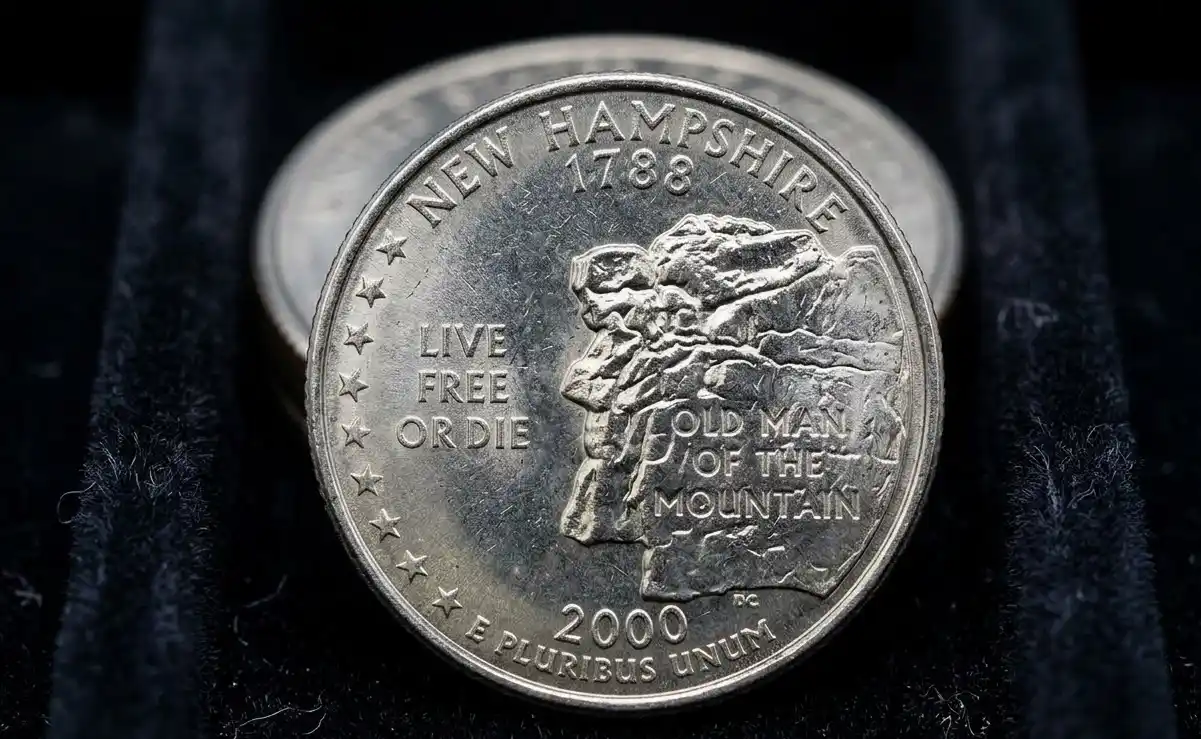
Physical dimensions follow standard US Mint requirements for both copper-nickel and silver versions.
| Parameter | Standard Issue | Silver Issue |
| Outer Layer | 75% copper, 25% nickel | 90% silver, 10% copper |
| Core | 100% copper | None (Solid strike) |
| Weight | 5.67 g | 6.25 g |
| Diameter | 24.26 mm | 24.26 mm |
| Thickness | 1.75 mm | 1.75 mm |
| Edge Type | Reeded (119 reeds) | Reeded (119 reeds) |
The Old Man of the Mountain
Cannon Mountain’s rock profile serves as the central focal point of the reverse side.
Glacial activity formed this structure approximately 12,000 years ago.
Five distinct granite ledges combined to create the human-like silhouette.
Standing 40 feet tall and 25 feet wide, the stone face was a massive natural monument.
Erosion and freeze-thaw cycles caused the formation to collapse on May 3, 2003.
This 2000 coin represents the final official government issue depicting the landmark while it was still intact.
Mintage Statistics by Mint Branch
Production was split between three primary U.S. Mint facilities.
Total mintage exceeded one billion units, heavily influencing current market liquidity.
- Philadelphia (P): 674,800,000
- Denver (D): 494,400,000
- San Francisco (S, Clad Proof): 3,082,463
- San Francisco (S, Silver Proof): 965,420
Philadelphia’s output surpassed Denver’s by 36.4%.
High availability in circulation means basic sets are easily completed without a premium.
Pricing Categories and Auction Records
Coin value depends entirely on preservation, measured by the 70-point Sheldon scale.
Circulated specimens generally carry only face value.
Mint State (MS) examples show significant price appreciation at MS-67 and above.
Current market indicators for various grades:
- MS-65 (P/D): $1.25-$2.00
- MS-66 (P/D): $5.00-$12.00
- MS-67 (P/D): $25.00-$65.00
- MS-68 (P/D): $400.00-$850.00
- PR-69 DCAM (Silver): $15.00-$22.00
- PR-70 DCAM (Silver): $85.00-$110.00
Heritage Auctions recorded a top price of $1,495 for a Philadelphia (P) strike in MS-68.
Denver (D) specimens in the same grade have topped $1,093.
Silver (S) examples in PR-70 remain stable, though they lose roughly 2% in annual value due to an increasing population of certified coins.
Wear Analysis and Minting Errors
Heavy use in commerce leads to a rapid loss of relief detail.
Initial wear typically appears on the protruding granite ledges of the “forehead” and “nose.”
Documented minting errors significantly increase collector value.
Notable deviations include:
- Double Die Reverse (DDR)
- Die Cracks on the motto lettering
- Weak strikes on the left-side stars
- Planchet lamination (layer peeling)
Coins featuring a strong double die on the “2000” date can fetch $150-$300.
Minor die cracks add between $5 and $20 to the price.
PCGS Population Report Statistics
Rarity is dictated by the number of coins surviving in top-tier grades.
Fewer than 40 units exist for the 2000-P in MS-68 condition.
Denver’s 2000-D population at MS-68 stands at 52 units.
No MS-69 grade has ever been recorded for the standard circulation strike.
Over 5,000 silver 2000-S coins exist in PR-70 DCAM.
High populations for perfect Proof coins limit their long-term investment growth.
Hidden Varieties
Advanced numismatists focus on finding “Die Clashes.”
This defect occurs when Washington’s outline ghosts onto the reverse near the rock profile.
Such specimens aren’t listed in basic catalogs but sell on eBay for $50-$100.
Pay close attention to micro-cracks on the word “MOUNTAIN” and check such details with the free coin identifier.
Metal flow lines connecting the “N” to the rim are considered collectible mint errors.
Value for these finds fluctuates based on the visual aggression of the defect.
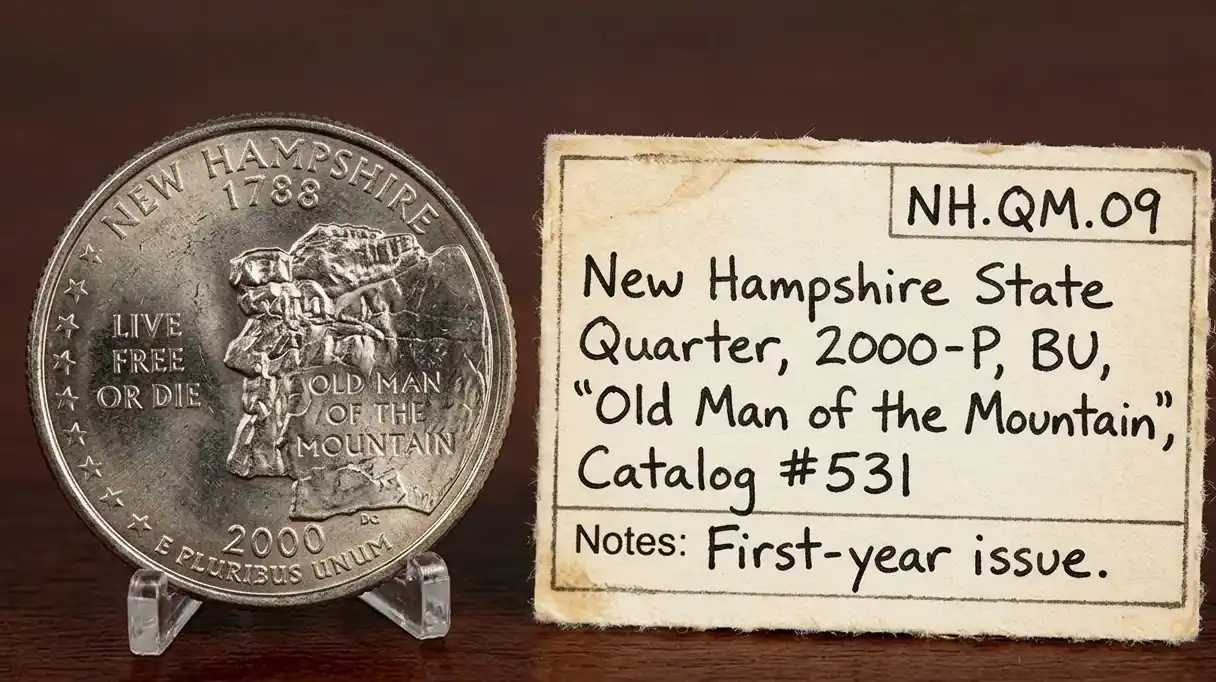
Pro Techniques for Bank Finds
Searching for rare 2000 quarters in bank rolls requires a systematic approach.
Collectors often order $500 boxes for high-volume screening.
Original Bank Wrapped (OBW) rolls from 2000 are the primary targets.
Finding an MS-67 specimen is much more likely in these rolls than in loose change.
Any coin found with perfect “luster” (original mint frost) should be encapsulated immediately.
Labor costs are justified if a single MS-68 specimen is recovered.
Investment Risks: The Grading Trap
Buying MS-67 slabs is often a losing strategy for investors.
The supply of certified MS-67s grows faster than collector demand.
Smart money only enters positions for MS-68 coins during auction lulls.
Counterfeit slabs exist for high-value positions, making verification essential.
Checking certificate numbers on PCGS or NGC websites is a mandatory step.
Sellers must account for auction fees, which typically take 15-20% of the hammer price.
Speculative Manipulations on eBay
Listings titled “Rarest 2000 New Hampshire Error” frequently flood marketplaces.
Sellers often mistake post-mint damage (scratches) for genuine errors.
Distinguishing a mechanical hit from a die defect is a critical skill.
True “off-center” strikes are exceptionally rare for this specific state.
A 5% shift adds about $25, while a 50% shift can exceed $500.
Experienced buyers rarely bite on these listings, keeping real sales volume low.
Building an Elite Set
Assembling a top-tier state quarter set requires “Top Pop” (highest population) examples.
New Hampshire is often a “bottleneck” state due to the reverse’s fragile relief.
Locating a coin with zero “bag marks” (contact hits) on Washington’s cheek can take months.
Professionals prefer buying at live coin shows where a loupe can be used in person.
Digital photos often hide micro-scratches through clever lighting.
A CAC sticker on the slab increases liquidity by roughly 30%.
Professional Grading Methodology
Authenticity checks involve verifying weight and magnetic properties.
Microscopes or the coin finder app is necessary to spot traces of cleaning.
Harshly cleaned coins lose almost all value, dropping to face value.
Evaluation of the reverse centers on the boundaries of the stone layers.
Hairlines (micro-scratches) on Proof fields will drop a grade from 70 to 68.
Grading agencies charge fees ranging from $20 to $50 per coin.
Storage and Conservation
Copper-nickel alloys will darken if exposed to sulfur or high humidity.
Moisture often causes corrosion spots along the exposed copper edge.
PVC-free albums are the only recommended long-term storage solution.
Direct skin contact leaves oils that trigger permanent oxidation.
Storage environments must be climate-controlled to avoid temperature swings.
Individual holders provide essential protection against mechanical damage during transit.